2 days
Daily Tour
10 people
Espanol, Francais
Rise of the Mughals
What: In this script we get to know about the rise of the Mughal kingdom in India, their legacy, everyday life in the times of the Mughals, glimpses into the life of the royals, traditions and ruling structure.
Why?
Agra as a city prospered during the times of the Mughals and most visitors here come to see the Taj Mahal. Understanding the Mughal dynasty will make people appreciate the architecture more and enable them to see these as more than just stone monuments but as part of the story of one of the most powerful dynasties of the world.
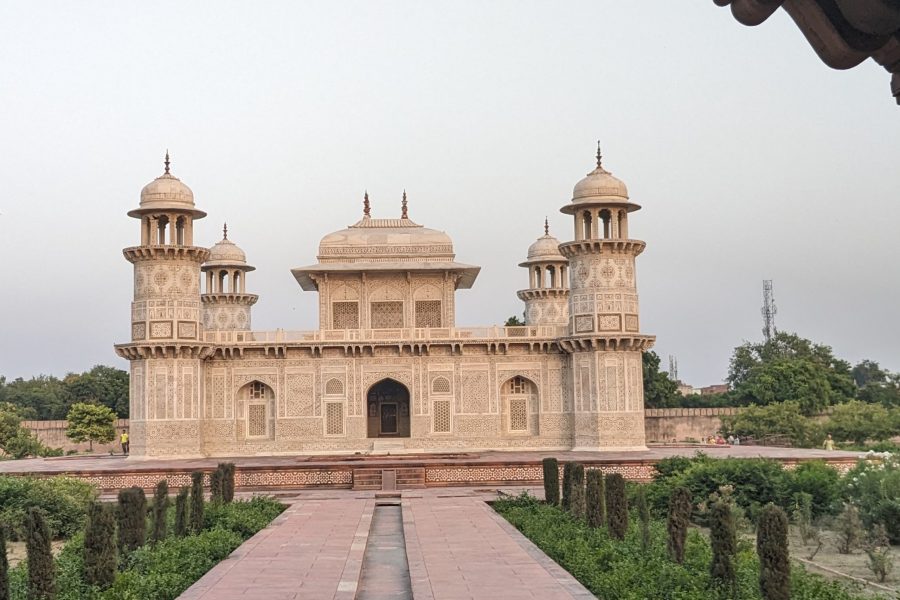
Where? Preferable monuments Aram Bagh, Red fort, Sikandra
How about we have a drum roll in the beginning, as we are about to start the story of the mighty Mughals. Kings of the kings and the great Padshah’s of the land of Hindostan
Highlights.-
Who are the Mughals? lineage.
Who was Babur? Place of birth, entry to India, last letter.
Babur enters India.
Like all stories, this story also began a long long time ago in the faraway land of Ferghana ( Capital of Fergana region in eastern Uzbekistan. Babur was born in Andijan – a city in Fergana ). A small little boy was spending time on one of the battlements of the fort. They were probably talking about the beautiful scenery of the valley and as the general tradition goes the father was telling the son about their family history. Abu Said Mirza & Qutlugh Nigar Khanum had a distinctive lineage tracing themselves back to Taimur and Chagatai Khan ( the second son of Changez/ Genghis Khan ). Suddenly a group of doves passed by them ( dove flying probably was a sport enjoyed by the royalty, the same sport exists in Agra ) and one of the doves landed on the shoulder of Mirza who lovingly took it into his palm and started caressing the bird. There was a loud sound and Babur saw that the battlement crashed taking his father down into the valley, when he looked down the only thing he saw was the white dove painted in the blood of his father. This incident changed the fate of the young boy who would later go on to conquer the lands of Samarkand, Kabul, and establish a lasting dynasty in Hindustan. Babur ( means tiger, his real name was Zahir-ud-din or the defender of the faith, perhaps his central Asian army could not pronounce the name and hence Babur ) became the king at the age of 13 and beheaded one of his ministers soon for acts of treason.
Over the 3 decades (1497 – 1530) Babur conquered, reigned, lost, and reconquered the kingdoms of Ferghana, Samarkand, and Kabul. Finally coming to India and defeating the Lodhi king Ibrahim Lodhi. Babur in his book Baburnama writes about his longing to create a kingdom that is big and stable and does justice to his ancestors. Babur came to India with the claim of re-capturing the land of his fore-father Taimur who had raided India in 1398 and defeated Muhammad Bin Tughlaq. It is interesting to see how rulers always tend to base their claim to rule, I see it as a reason to fight, and when there are no reasons we tend to invent reasons. Like the Iraq war with Saddam Hussain where America sent its army to attack Iraq killing thousands of people but finding no chemical weapon stockpile which was the reason given for the invasion of Iraq.
When Babur came to Hindustan after crossing the river Indus (the land east of Indus was known as Hindustan ) he was to face the huge imperial army of Ibrahim Lodhi at Panipat. Experts say that Lodhi had a number of around 60-100,000 men while Babur had between 15-30,000 men but still Babur’s forces were able to defeat the forces of Ibrahim Lodhi. Can you guess why it was? It was because Babur had field guns. This was the first time that field guns were used in India. Hundreds of elephants died along with people. Technology is crucial in the field of war which perhaps explains why Israeli or American forces are far ahead of others. But then why war in the first place is another thing we can ask ourselves ? have we really evolved out of the medieval mindset? This could be an open question to the group.
The troupe of Babur captured Delhi and Humayun secured the city of Agra which had the royal treasury and this is where the Koh-i-Noor diamond was gifted to Humayun by the caretaker of the fort. It is said that the diamond alone was worth 3 days of GWP ( Gross world product ).
Babur passed away after 4 years of ruling India. It is said that in his last letters to Humayun he asked him to respect the traditions of India saying, “ It is but proper that you, with a heart cleansed of all religious bigotry, should dispense justice according to the tenets of each community. And in particular refrain from the sacrifice of a cow, for that way lies the conquest of the hearts of the people of Hindustan;”.
Mughals come from the word Mongols or the Barbarians as the sophisticated Persians used to call them. The Mughal kings referred to themselves as Gurkhani or the son in law of the Khan ( referring to Changez Khan; Babur’s mother was a great great great grand-daughter of Chaghtai who was the second son of Changez Khan ).
From Never kill a Timurid prince to Takht Ya Takhta
In the Timurid clan, it was prohibited to kill a Timurid prince. The same philosophy was taken forward by Humayun who despite being attacked multiple times by his brothers never killed any of them even when he had a chance. Humayun had to go into exile as he was defeated by Sher Shah Suri.
The importance given to the Timurid prince would over time fade away and be displaced by another famous saying Takht ya Takhta or crown or coffin. From Jehangir onwards, the succession battles started claiming the lives of their own family members. Jahangir had to blind his own son Khusraw and later Shahjahan on January 23, 1628, upon his orders, Dawar, his brother Garshasp, Shahryar, and Tahmuras and Hoshang, sons of the deceased Prince Daniyal, were all put to death by Asaf Khan. Later Aurangzeb will kill his brother Dara Shikoh.
This gives me a feeling that somehow the Mughal emperor grew so big that it became autoimmune, ridding itself of itself.
Anyway, so Humayun lost the throne and had to go to Persia to seek refuge and he was able to gain back his kingdom only through the help of Persian king Safavid’s aid. Humayun’s return from Persia was accompanied by a large retinue of Persian noblemen and signaled an important change in Mughal court culture. The Central Asian origins of the dynasty were largely overshadowed by the influences of Persian art, architecture, language, and literature. There are many stone carvings and thousands of Persian manuscripts in India dating from the time of Humayun.
But Humayun would not stay the king for long and he lost his life as he fell down from the stairs of his library. There are various stories attributed to it, some say he fell down as he was inebriated others say that he heard the call to prayer and his instinctive reaction was to bow, others say that he had seen a comet in the sky and he was so amazed by it that he did not register the steep stairs. The building from which he fell to death is still there in Delhi.
After Humayun’s death, Akbar became the king. His full name was jalal Ud Din Muhammad Akbar. Akbar like his grandfather became king at the age of 13 and for the first few years, he was protected by Bairam Khan and his grandmother Maham begum. It was only when he was seventeen was e allowed to make decisions for the kingdom.
A very interesting incident happened in the first few years of the death of Humayun. For over a year no one knew that the emperor was dead as Hamida and Bairam Khan used to use a body double who would come into the palace at night and be seen by the people in reflections. This was done so that enough arrangements can be made to safeguard the throne for Akbar and so that no other king attacks the kingdom in absence of the emperor.
Akbar was one of the kings who contributed extensively to broaden the empire and he introduced key reforms that provided the empire with stability. These included the Mansabdari system ( The Mansabdari system was the administrative system of the Mughal Empire introduced by Akbar. The word Mansab is of Arabic origin meaning rank or position. The system, hence, determined the rank of a government official. Every civil and military officer was given a ‘Mansab’ and different which could be increased by ten were used for ranking officers. It was also meant for fixing the salaries and allowances of officers. The term Manasabadar means a person (in old times) who has a positioning or ranking of a government.) , matrimonial alliances, secular governance. He also institutionalized the Zenana. It is said that Akbar could not read or write but some experts suggest that this was his way to make himself be compared with Muhammad who himself could not read or write.
King as shadow of the God
In the Medieval world, the king was the representative of god or the shadow of God. From all Mughal kings, it is Akbar who was able to reach the closest to being God-like. He declared himself as the arbitrator of religion and even started a religion himself called Deen-E-Ilahi. In Mughal India having a dialogue between various religions was a common thing. One fatal flaw in the case of Akbar was that he stuck to the throne for too long leading to succession battles between his successors. Whenever the king is on the throne for too long there is a problem, be it in the case of Ashoka, Akbar, or Aurangzeb ( Aurangzeb was king till the age of 88, he ruled for 49 years. Akbar reigned for 51 years and died when he was 66 year old). The problem that happens is that the prince in waiting has to pass their time with limited duties that as seen leaves a lot of them dead ( names of his brothers who died because of intoxication ) or turns them against the emperor ( Jehangir, prince Khurram, Aurangzeb ).
Since after Akbar we see a shift in Mughal architecture. While earlier marble was used as a decorative element Jehangir-Nur Jehan duo starts making tombs in pure Marble inlaid with precious stones. The art of pietra dura had finally arrived from Persia to India. This same technique was later mastered during the reign of Shah Jehan and gave way to monuments like the Taj Mahal.
Interestingly Jehangir was the first King to be born of a Persian father and an Indian Mother. His mother was a Rajput her name was Harka Bai/ Jodha Bai and her title was Mariam Uz Zamani. While Akbar was born on Indian soil, Jehangir was born of Indian parents. There is this whole right-wing propaganda that wants to see anything Mughal as an outsider, this is something that they tend to ignore.
Jehangir’s reign is interesting as it is said that he co-ruled the empire with his wife Nur Jehan whom he dearly loved and admired ( Jehangir was his second husband, she was married to Jehangir at the age of 31 ). Jehangir had an interest in botany and gave generous grants to researchers for the subject. Nur Jehan was a clever administrator ( she rescued the emperor from Mahabat Khan during their Kashmir journey ), skilled marksmen ( during one of the raids she killed 3 tigers with 5 bullets ), and a shrewd politician ( she managed to limit the growing powers of prince Khurram lest there be a rebellion by the prince ). Nur Jehan further made her brother Asaf’s daughter Arjumand Banu Begum ( late called Mumtaz Mahal ) married to Khurram ( Shah Jehan ). Thus she made sure that her family fortune flourished which did as her father Mirza Gheyas Beig was made It Mad Ud Daula – the pillar of state and her brother Asaf was a prominent minister in the times of Shah Jehan. Quite a change of fortune for a family which came seeking refuge just a few decades back. In fact, Nur Jehan was even stranded on their family’s journey to Hindostan.
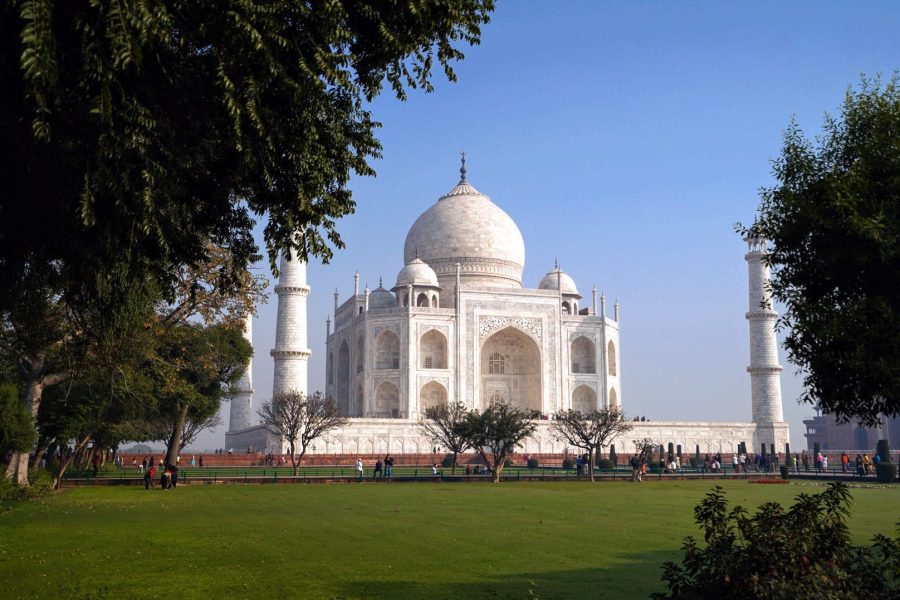
After Jehangir came Shah Jehan who is most famously known for commissioning the Taj Mahal for his wife Arjumand Bano Begum who dies giving birth to their 13th child in their 19th year of marriage. Shah Jehan was a star kid he shared his birthday with Taimur and he was groomed by the emperor Akbar himself. Shah Jehan enjoyed a relatively peaceful empire and he is known for his love of constructing cities, buildings. It is in his time that Mughal architecture reaches its zenith.
Post Shah Jehan is Aurangzeb who had to behead his brother Dara Shikoh to reach the throne. Aurangzeb was the last of the great Mughals and post him there is a steady decline of the Mughal dynasty which came to an end in 1857 by the final dethronement of Bahadur Shah Zafar, the last Mughal emperor.
Transfer of power
When Babur defeated Ibrahim Lodhi he did not kill all his family members or ministers. That would have made him unable to control the empire and would have made his subjects dislike him. While the emperor rules with force but he has to be likable by the public else he becomes a dictator. So when the emperors went to war for them it was business of power, it was an exercise, there have been various instances where the kings become allies post-war. But who pays the real cost of war? It is the soldiers who sacrifice their lives and the common people who lose their livelihood and are made to pay taxes that fund these wars. There are two factions the powerful and the powerless. The people with power belong to the same faction and no matter which faction is in power they will secure the interests of their own community which is that of the powerful. This limits power within the same circles and was as true in medieval times as is in the present era.
Everyday life
The king was the head of the state. India enjoyed prosperity and political stability during the rule of Akbar, Jehangir, and Shah Jehan. The GDP was around 30% for the 200 years of their rule.
The emperor, the nobles, traders, and industrialists, of course, enjoyed the maximum share of this prosperity, yet, the common people were not devoid of daily necessities of life as all articles were cheaply available. The emperor was the highest beneficiary.
He not only collected many taxes but was also the best trader and industrialist. He maintained many industries (Karkhanas) which produced a large variety of articles that were sold in the market and constituted a good source of his income.
He, therefore, led a most luxurious life. Next to him were his Mansabdars and Rajput kings. They enjoyed extensive Jagirs besides heavy salaries from the state. They enjoyed the best of their lives till they could afford it.
The profession of the majority of the people was agriculture. More than seventy-five percent of the population lived in villages and were directly or indirectly connected with land. Wheat, barley, gram, maize, rice, millets, linseeds, pulses, sugarcane, jute, poppy, indigo, fruits, vegetables, etc. were produced in different parts of the country.
Below them were the members of the bureaucracy. Most of them were also well-placed. Among them, only petty civil servants and slaves were the least beneficiaries. The traders and industrialists were divided into several categories.
The instruments which were used in agriculture were practically the same which were being used in India till the first half of the twentieth century. The peasants depended on rains, ponds, wells, and canals for irrigation. The peasants suffered from famines from time to time. Famines were followed usually by epidemics which resulted in the loss of lakhs of lives. Yet, with all these difficulties it can be said that the country was self-dependent from the point of view of agriculture.
Industries: Many prosperous cities grew up during the period of rule of the Mughals. There were numerous ports on the sea-coast of Gujarat, Bengal, and the Deccan. People from different European countries came to India for the purpose of trade. All these were proofs of the industrial growth of India because agriculture alone could not lead to such economic prosperity. The sugar industry, indigo, and opium (exported), produced swords, javelins, and other traditional arms of good quality but they failed to produce cannons and rifles of good quality. Punjab and Gujarat were renowned for the production of good-quality arms. Copper, brass, and bell-metal were used for preparing utensils and idols. Delhi was famous for its copper industry; the bell-metal industry was well-developed in Bengal, and Banaras was famous for its brass industry. The Mughul emperors built a large number of forts, palaces, mosques, etc. The Rajput rulers too constructed forts and palaces in large numbers. Therefore, stone-cutters and mansion-builders were also found in large numbers in India. Silk cloth was colored in different colors and clothes were made of it. The emperors themselves had many Karkhanas for this purpose at Agra, Lahore, and Ahmedabad. Yet, India imported silk of good quality from foreign countries particularly from China which meant that the silk industry was not in a well-developed stage. According to Abul Fazl, Akbar started one thousand Karkhanas for producing woolen cloth at Lahore. Jahangir established such Karkhanas at Amritsar. Thus, the woolen cloth was produced in India on a large scale and received praise from contemporary foreign visitors. Yet, the industry could not grow much because of the non-availability of good quality wool. Indian cotton cloth was in demand in China, Japan, Persia, Arabia, Egypt, Africa, and many European countries. most of the Indian industries were limited to individual families. The workers, therefore, had no facility for proper training. The professions were mostly hereditary and so was the training which the artisans received.
Trade: They also constructed good roads and sarais which helped inconvenient transport and travel. The Mughul rulers also did not charge much trade tax. Mostly, it remained 3 ½ to 5 percent both on imports and exports. Internal trade was carried on both by roads and rivers while foreign trade was carried on by sea and roads. India had trade relations with different countries of Europe, Africa, and Asia like France, Holland, Portugal, England, Arabia, Egypt, Central Asia, Persia, Ceylon, China, Japan, Nepal, etc. India imported woolen cloth from France, silk from Italy and Persia, carpets from Persia, raw-silk from China, and horses from Arabia and Central Asia. As gold and silver were not found much in India, India imported them also.
Social Condition: The majority of Indian society consisted of Hindus. Traditionally, they were divided into four castes, viz., the Brahmanas, the Kshatriyas, the Vaisyas, and the Sudras. Besides, the Hindus were subdivided into different sub-castes. The caste system was rigid and there were strict restrictions on inter-dining and inter-caste marriages. The caste determined the profession of individuals. Besides the Hindus, Buddhists, Jains, Sikhs, Parsis, Christians, and Muslims were other religious communities in India.
The Muslims were primarily divided into two parts. The one consisted of foreign Muslims like the Arabs, the Persians, the Turks, the Mongols, the Uzbeks, the Abbysinians and the Armenians. They regarded themselves as superior to converted or Indian Muslims on the basis of the purity of their blood. They enjoyed the best social status and highest services in the state.
Islam prohibits the drinking of liquor, wine, etc. Yet, all Mughul emperors except Aurangzeb and their nobles were addicted to it.
Dress, food habits, ornaments, etc. underwent important changes during the Mughul rule. Upper and middle classes both among the Muslims and Hindus wore Qaba (long coat coming down to the knees) and tight trousers while the common men among the Hindus wore Dhoti and the Muslims Kurta and Pajama. Both the Hindus and the Muslims wore turbans though their styles differed. Shawls both woolen and cotton were also used by men.
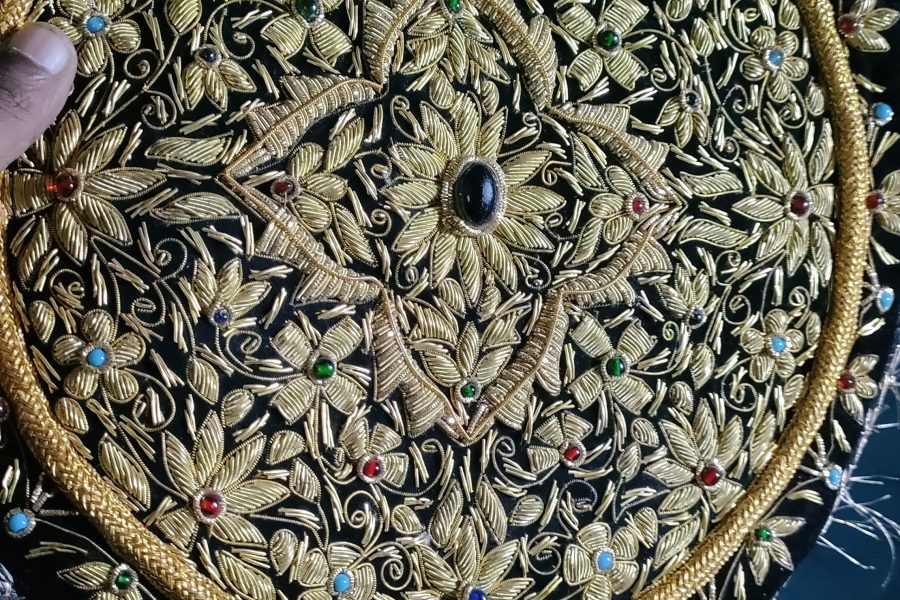
The emperors, nobles and the rich people got stitched gold-thread, pearls, and even diamonds on their garments. Only rich people could afford to wear shoes or chappals. Ornaments were used both by males and females. While the males wore earrings, finger rings, and necklaces, the females wore all sorts of ornaments from head to toe like bracelets, rings, necklaces, etc.
Hindu ladies wore Dhoti and Angiya and the Muslim ladies wore pajama, Ghagra, jacket, dupatta, etc. A large variety of cosmetics were used by the ladies. Asmat Begum, mother of Nur Jahan prepared rose-perfume while Nur Jahan and Mumtaj Mahal brought about improvement in cosmetics and ornaments.
The diet of the Hindus and the Muslims of the upper classes was not very much different. Meat, roti, rice, fruits, milk, butter, ghee, etc. were their common diet. Good food of a large variety was prepared with the help of all sorts of spices among the rich people. Common people limited their diet only to rice, roti, pulses, vegetable, milk, etc.
The Jains and the Brahmanas at certain places avoided meat. Otherwise, both the Hindus and the Muslims, in general, were non-vegetarians. People used wine, liquor, opium, and tobacco as intoxicants.
Music, dance, boating, display of dramas, etc. were the means of entertainment of the people. Chess, chaupar, card-playing, wrestling etc., were favourite games of the people. Animal fighting, Chaughan (horse-polo) and hunting were entertainment of emperors and nobles.
Different fairs and festivals served religious as well as entertaining purpose. Naurauj, Id-ul-Fitr, Id-ul-Zuha, Bara Wafat, Ramzan etc. were important Muslim festivals. Among festivals of the Hindus, Holi, Diwali, Dussehra, Basant, Durga Puja, Ganesh Puja etc. were important festivals. Emperors and nobles also participated in all these festivals.
Besides, celebrations were held by the court on birthdays of emperors and princes. Common people also participated in all these fairs, festivals and celebrations. Therefore, these occupied an important place in the social life of Indians. One novelty of Indian social life during the reign of the Mughuls was that the Hindus and the Muslims came closer to each other as compared to the period of the Delhi Sultanate.
The policy of religious toleration pursued by Akbar and the teachings of saints like Nanak, Kabir, Malukdas, Dadu and different Sufi saints created that atmosphere in which both the Hindus and the Muslims could understand the utility as well as the necessity of living with each other in harmony. This helped in making Indian social life more peaceful and liberal as compared to the social life during the period of the Delhi Sultanate.
Education: During his ( Akbar’s ) rule, the Hindus started studying Persian and the Muslims studied Sanskrit. It facilitated the translation of many Sanskrit treatises into Persian. Jahangir was also liberal in providing financial assistance to educational institutions of both the Hindus and the Muslims.
Delhi, Agra, Fatehpur Sikri, Lucknow, Ambala, Gwalior, Kashmir, Allahabad, Lahore, Jaunpur, Sialkot, etc. were centers of education for the Muslims. Persian was the language of teaching in all maktabs and madrasas.
Many madarsas among them became quite famous for the study of different subjects, viz., Farangi Mahal Madarsa at Lucknow became famous for the study of law; the madrasa of Shah Wali Ullah at Delhi became renowned for the study of traditional values of life; and, the madrasa at Sialkot was famous for the study of grammar.
The fame of a madarsa depended on the teachers or scholars of that madarsa. There were no examination system at that time. The admission and promotion of a student depended entirely on his teacher. Therefore, the knowledge of a student was judged by the school where he had studied and the teacher who taught him.
Three types of degrees were awarded to students. Those who studied logic and philosophy were awarded the degree of Fazil; those who studied religion were awarded the degree of Alim; and, those who studied literature were awarded the degree of Kabil.
The Hindus were keener in education as compared to Muslims and they established pathsalas even in villages that were attached to temples. A child was sent to pathshala at the age of five where he studied for four years without any fee. For higher studies, a student had to seek admission in a vidyapith.
The state paid no attention to the education of the masses. Female education was negligible and there was no arrangement of technical, industrial, and professional education in schools and colleges for which students had to depend on their families or Imperial Karkhanas. Therefore, education suffered and failed to progress which resulted in the backwardness of the country in all spheres of life.
Fine Arts: Mughul emperors were interested in fine arts. They were particularly fond of buildings. Therefore, among fine arts, architecture flourished most during the period of their rule.
Akbar possessed a national attitude and that reflected in all fine arts which grew and developed during the period of his rule. He employed designers and architects both from among the Hindu and Muslim artists and gave them perfect freedom to construct his buildings on the model of Hindu or Muslim or mixed art.
It helped in the adjustment of both types of architecture and the net result was the creation of a new type of architecture called the Mughul architecture. Besides, Hindu artists being in the majority and the necessity of constructing buildings according to the climate of the country also helped in molding Mughul architecture.
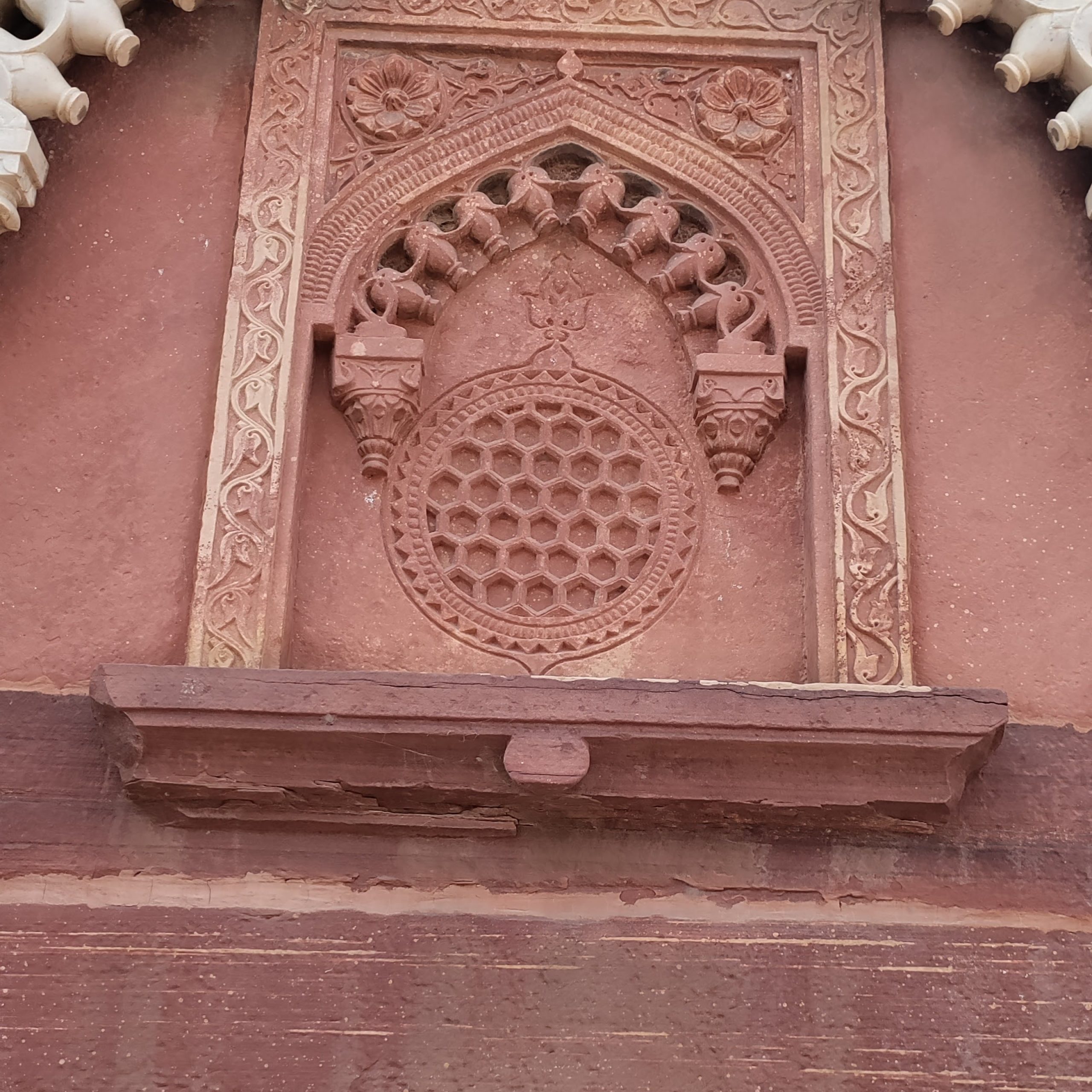
Some basic features of Mughul architecture were the construction of round domes, high minarets, mihrabs, pillars of varied types, open courtyards, etc. in the buildings. Thus, architecture progressed well during the rule of the Mughals and a large number of mausoleums, mosques, etc. were constructed. It occupies a most significant place in the history of Indian architecture. It also influenced the provincial architecture of its times. It would be wrong to say that the Mughul architecture was primarily foreign.
On the contrary, it is nearer to the truth that it was basically Indian though, of course, it accepted and merged foreign influences within it. The buildings that Mughul emperors erected are certainly, different from the buildings constructed in Turkey. Persia and Central Asia.
The construction of the Taj Mahal could be possible only in India and attempting to copy it has not been possible in other countries. Therefore, the Mughul architecture was thoroughly Indianised and produced some finest buildings ever produced in India.
Painting: Babur and Humayun came in contact with this Persian art and tried to introduce it in India. Akbar gave protection to many foreign painters particularly from those of Persia. But, he did not remain satisfied with that only. He encouraged Indian painters as well and employed a large number of them in his service. When Persian and Indian artists got an opportunity to work together, they learned and influenced each other.
Thus, the Persian and Indian schools of painting influenced each other which resulted in the growth of the Mughul school of painting. The Mughul school of painting gradually made itself free from foreign influence, pursued its own independent course, and, in this process, was Indianised.
Babur and Humayun did not accept the prohibition of Islam concerning the art of painting. When Humayun got shelter in Persia he came in contact with two disciples of the famous Persian painter Bihzad namely Abdul Samad and Mir Sayyid. He invited them to come to him. Both of them joined him when he reached Kabul and came to India along with him. Humayun and Akbar took lessons in painting from Abdul Samad. But, it was just the beginning.
When Akbar became the emperor, he encouraged painters at his court and helped in the growth of this art. He established a separate department of painting under Abdul Samad and ordered to prepare paintings not only on books which was the usual practice so far but also to prepare frescoes on palace-walls in Fatehpur Sikri.
He wrote in his biography, Tuzuk-i-Jahangiri:
“As regards myself, my liking for painting and my practice in judging it have arrived at such a point that when any work is brought before me, either of a deceased artist or of those of the present day, without the names being told to me, I can say at the spur of the moment that it is the work of such and such a man. And if there be a picture containing many portraits, and each face be the work of a different master, I can discover which face is the work of each of them. If any person has put in the eye and eyebrow of a face, I can perceive whose work the original face is, and who has painted the eye and eyebrows.”
Aurangzeb withdrew the royal patronage which was given to the artists. He turned them out of his court and even destroyed certain paintings because the practice of this art was prohibited by Islam. The art of painting, thus, suffered at the court of Aurangzeb. But it brought out some advantages indirectly.
The painters dismissed from the Emperor’s court found shelter in the courts of different Hindu and Muslim provincial rulers. It resulted in the growth of different regional schools of art and brought this art closer to the people. Among the Later Mughul emperors, some tried to encourage painting but they lacked sufficient resources.
The painters did not attempt to depict religious stories of Islam in their paintings but the Hindu and Christian tales were freely used as mediums of their paintings. The artists also attempted to depict lives of great emperors through their paintings. They attempted to produce Hamzahnama,/ Baburnama, Timurnama, Razamnama, Shahnama, Lilavati, Akbarnama, and the story of Laila-Majnu in their paintings.
A day in the court
It is important for us to imagine what these monuments that we are seeing today looked like in their days. These monuments that we see now are just like an apartment without any furniture. We have to use our imagination to fill these spaces with the furniture from the day. It is said that every inch of the floor in the red fort was covered in carpets. There would be lamps ( Akash Diya ), curtains, tables, baskets of fruits, musicians, servants, soldiers, trumpeters, Mughal gardens ( unlike the victorian gardens ), flag posts, and scents of course. These would give a rich feeling to the emperor. Events would be marked by music that emphasized the actions of the emperor and the mood of the event ( Jharokha darshan eg ). So different music for cremation or for the crowning of the king. The music would further accentuate the emotions of the people. Moreover, bright-colored clothes were worn by courtiers to reflect the low luminosity light through the lamps. Special chambers were created that reflected light ( Sheesh Mehal ) for night performances. The emperor himself wore clothes with gold threads and ornaments these clothes made him appear distinct from the other people and made him look almost god-like.
In the war zone, the king had an elite Rajput guard protecting him and his war weapons were way sophisticated than the regular soldiers. In fact, it was very less likely for the king to die in combat. But if the king was dead or was missing from the combat his army would surrender in need of a leader ( as in the case of Dara Shikoh who dismounted his elephant to secure one of his fallen noble and his army took this as the sign of the death of emperor thus changing loyalties).
An ongoing war was one of the most interesting and traumatic things. But interesting things happened, there are stories of trickery ( Humayun vs Suri / Nur Jehan vs Mahabat khan ), of outright stupidity/honor ( Jauhar by the queens of Chittorgarh ).
It is said that the Mughal caravan was so huge and elaborate that it would take it 8 hours to pass a particular spot. These were basically cities on move.
Interesting points to talk about:
Mughal women
The Harem
The food habits
Drinking and drugs
Hunting
Incidents – Akbar tried running onto his sword, elephant fights, Babur’s epic majun trips and drinking games, Akbar’s fight with Adham khan inside haram, Akbar running around the periphery of the fort with soldiers in his hands. Court rivalries, Jehangir and khusrau, story of Ibrahim Lodhi’s mother and how she tried to poison Babur, Babur exchanging his life for that of Humayun.
Link: http://www.historydiscussion.net/history-of-india/mughal-emperors/life-during-the-rule-of-mughals-indian-history/6625
https://www.jstor.org/stable/pdf/4169650.pdf?refreqid=excelsior%3A380eaf859484abd6ee63eb7cb62bead8
https://www.rarebooksocietyofindia.org/book_archive/196174216674_10154956199821675.pdf
https://satyagrah.scroll.in/article/16718/was-the-aurangzeb-most-evil-ruler-in-indian-history
Babur’s letter to Humayun
“Oh my son! The realm of Hindustan is full of diverse creeds. Praise be to God, the Righteous, the Glorious, the Highest, that He hath granted unto thee the Empire of it. It is but proper that you, with heart cleansed of all religious bigotry, should dispense justice according to the tenets of each community. And in particular refrain from the sacrifice of cow, for that way lies the conquest of the hearts of the people of Hindustan; and the subjects of the realm will, through royal favour, be devoted to thee. And the temples and abodes of worship of every community under Imperial sway, you should not damage. Dispense justice so that the sovereign may be happy with the subjects and likewise the subjects with their sovereign. The progress of Islam is better by the sword of kindness, not by the sword of oppression.
Ignore the disputations of Shias and Sunnis; for therein is the weakness of Islam. And bring together the subjects with different beliefs in the manner of the Four Elements, so that the body-politic may be immune from the various ailments. And remember the deeds of Hazrat Taimur Sahib Qiran (Lord of the conjuction) so that you may become mature in matters of Government. And on us is but the duty to advise.”
| # | Discount group | From adult | To adult | Value |
|---|---|---|---|---|
| 1 | Group 3-5 | 3 | 5 | 10% |
| # | Discount group | From children | To children | Value |
|---|---|---|---|---|
| 1 | Group 2-6 | 2 | 6 | 12% |

Member Since 2025




Leave a review